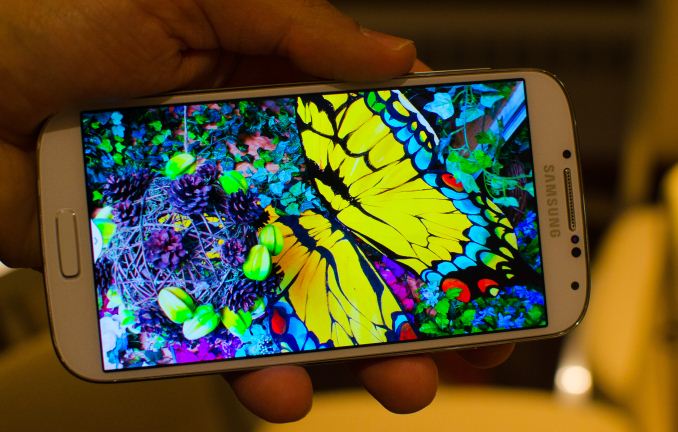
It simply stands for Active Matrix Organic Light Emitting Diode. It was widely introduced by Samsung in its flagship phones (Galaxy S, Galaxy S II, Galaxy S III, Galaxy S4), and supplied to other phone manufacturers (HTC, Google). It is praised for its ultra fast reponse time , significant low power usage without the need of back lighting, and mostly its representation of more vibrant colours than IPS LCD.
However, it has drawbacks too. The organic materials used in AMOLED are more prone to degradation overtime, resulting in color shifts as one color fades faster than another. However, technology has been developed to compensate for material degradation. Furthermore, PenTile technology is widely used to allow for a higher resolution display while requiring fewer sub-pixels, resulting in a less resolution display as compared with a non-pentile display (IPS LCD) with the same resolution. Lastly, the production cost of AMOLED is still substantially higher as compared to IPS LCD.
IPS LCD

It simply stands for In-plane-switching Liquid Crystal Display. It is commonly found in smartphones like Apple iPhone 5, Nokia Lumia 920, LG Nexus 4. It displays more consistent and accurate color from a wide viewing angles as compared to its predeccsor TN-LCD.
It boasts a non-pentile screen, which increase the screen resolution because of the increase of sub-pixels. Moreover, it is less prone to degradation, which reduces the probability of colour accuracy overtime. Most importantly, it represents more natural colour images than AMOLED.
However, it lacks the higher colour saturation, contrast and response time that AMOLED has.
Here is comparison between the two:

(Near Left : Galaxy S4 (AMOLED), Middle and far left: Apple iPhone 5 and HTC One (IPS LCD)
(Source: http://samsunggalaxy-s4.info/color-super-amoled-screen-samsung-galaxy-s4-very-natural_774.html)
Thus, what are your preference? AMOLED or IPS LCD? Please comment below to share your views!

What can we do to slow down AMOLED degradation?
ReplyDeleteThere are smartphones available that has Pentile AMOLED screens (eg. Samsung Galaxy S4); which degrades at a much slower pace than RGB AMOLED. Also, some manufacturers displays aim to increase the lifespan of AMOLED displays, pushing their lifespan by improving light outcoupling.
ReplyDeleteThank You for your response!
ReplyDelete